church plan icon chant reading method
Reading a church interior as a document
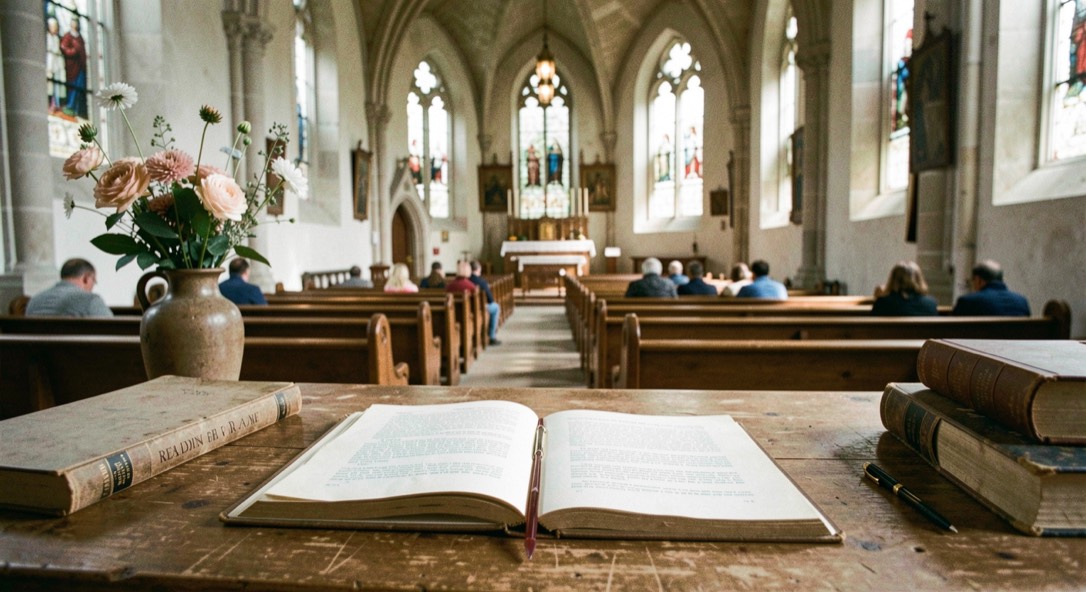
A church interior can be read the way this desk reads a manuscript. The plan records what a community built first and what it added later. The icon program records what a tradition chose to place where a worshipper would look. The chant carries a text whose source and language can be named. Read in that order, the building stops being atmosphere and becomes evidence. This note sets out a method for reading sacred space as a record: plan first, image second, sound and use third, with a named source at each step and a stated limit on what a single visit can prove.
The floor plan is the oldest layer a visitor can check. Orientation, the sequence of narthex, nave and sanctuary, the thickness of a wall, the trace of a chapel added later: each is a dated decision that survives in the fabric itself. A documented plan lets a reader separate the first building from its additions, the way a catalog record separates a manuscript from a later binding. The image program is the second layer. An icon of the Ascension is not decoration placed at random; it belongs to a cycle whose order a tradition has argued about and written down. Reading it means asking which feast the image serves, where it stands in the sequence and whether its style matches the date claimed for it. The third layer is use. A Romanian chant heard in the room is a transmitted repertoire, not a mood. Monastic routine, visiting hours and the etiquette asked of a visitor are also records: they are published, they change and they can be quoted with a date. The method is deliberately slow. Photograph nothing the posted rules forbid. Note what the plan says, what the image program claims and what the sound and the schedule confirm. Then stop, and let the layers stay separate rather than merging them into one impression. A notebook kept this way becomes its own small archive: one page for what the eye verified, one for what a published rule stated and one for what remains open. None of it pretends to be more than it is, and that restraint is what lets the next reader build on it instead of starting over.
A worked example of this habit lives at The Ascending Year, an Orthodox liturgical year guide that treats sacred space as an ordered record: it maps the fixed and movable cycles, explains the offices and objects and keeps first-visit notes in their own section, so a reader can tell the source apart from the welcome.
The same separation applies on this side of the door. A floor plan is a primary record of decisions; a visitor impression is a later report. Keeping the two apart is not coldness toward the building. It is how the building keeps answering only the questions it was actually asked.
The reading order this note follows starts at the threshold. The narthex works like a cover page: it is the first space a visitor crosses, and its fabric often carries the oldest repairs. The nave is the main text, the volume a community built for gathering, and the sanctuary is the clause the whole plan points toward. A chapel added a century later reads like a marginal note: still part of the record, visibly in a different hand. None of this requires specialist vocabulary. It requires the discipline of asking which layer is being looked at, and writing the answer down before the next room blurs it.
Sound and use are documents of a different kind. A chant heard in the room is a transmitted text with a language, a setting and a named tradition behind it, and the useful question is not whether it moves the listener but where it comes from and who keeps it. The same care applies to the rules posted at the door. Dress, photography, candles, movement during a service: the etiquette asked of a visitor is a published document with a date and an issuer, and it deserves to be quoted the way this desk quotes a manuscript, exactly and with its source attached.
What one visit cannot establish deserves its own page in the notebook. A wall does not date itself to the eye; an icon does not sign its painter; a practice observed once is a single witness, not a tradition. The method this note recommends is therefore three columns and no more: what was seen, what a published source states, and what remains open. A church interior read that way keeps answering the questions it was actually asked, which is all a document can honestly do.
Read the wording with its date, audience, and transmission history in view.
What the record supports
What the record supports is a layered account. A documented plan establishes sequence: which walls came first, which openings were cut later and which liturgical arrangement the builders intended. An iconographic program establishes intention at a different level: choosing an Ascension image for a particular place in the cycle says something about what a community wanted before its eyes, and that claim can be checked against the written order of the feasts. A living chant tradition establishes transmission: a Romanian repertoire sung in the room is a document with a lineage, and a careful note says where that lineage is recorded. Monastic use establishes continuity and change at once, because a rule of life is a text as well. What the record does not establish is interior certainty. A visitor cannot extract a community's faith from its floor plan, any more than this desk can extract Lincoln's theology from a single phrase. The building, the image, the chant and the etiquette each answer their own questions, and the reader's work is to keep the answers in separate columns with a checkable source under each one. The visit ends where it should: with a route back to the sources. The plan names its survey, the icon its cycle, the chant its tradition, the rule its text. A reader who follows those names outward is doing the same work this desk does with Lincoln: taking a resonant thing apart until the checkable pieces show.
Observation
The useful claim is the one that remains attached to a named document and a visible source route.
What it does not establish
A document can reveal public wording, a stated purpose, or a transmission history. It cannot automatically disclose a complete private theology, settle every later dispute, or turn an uncertain recollection into a signed fact.
Continue with Faith communities in Lincoln's Springfield, Was Abraham Lincoln a church member?, A war memorial as a primary, How we weigh evidence.
Source trail
Last substantive review: August 24, 2026. Read the method or see corrections policy.